AI Office
A landing page for something genuinely unfamiliar, written twice: once for an English-speaking reader, once for a Russian-speaking one, neither a translation of the other.
The problem
A landing page for something genuinely unfamiliar has a harder job than a landing page for a known category. Nobody arrives searching for it, so the page has to explain the idea, establish that it is not vapor, and ask for a call, in that order, before the reader gives up.
Two audiences, in two languages, with different instincts about what to be suspicious of.
The decision
Both languages are originals. The Russian and English versions are written independently and kept mirrored line for line: same number of sections, same number of cards, same claims. Neither is a translation of the other.
This matters more than it sounds. A translated page reads as translated, and a reader who senses translation discounts everything on it. The two versions do not share idioms, do not share sentence rhythm and do not share jokes, because a phrase that lands in one language is dead weight in the other. They share structure and facts.
No prices on the page. Deliberate. The tiers describe what is included, and the call to action is a fifteen-minute call. The only money mentioned on the page is other people's: what the underlying AI costs per month, what a freelancer costs. That comparison is the argument, and putting our own number next to it would have turned a demonstration into a negotiation.
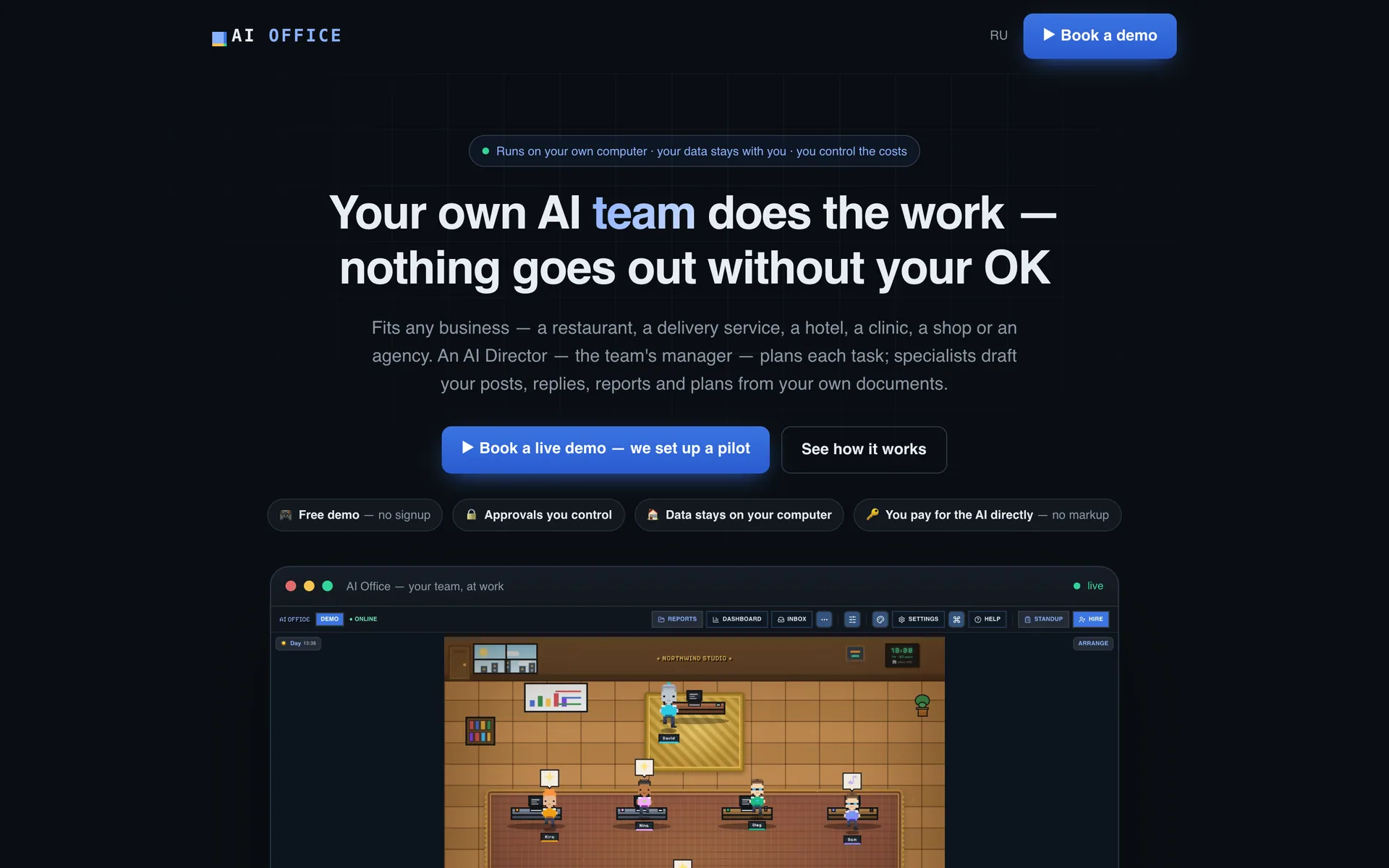
Show the product working. The page carries a real screenshot of the running interface rather than an illustration of one.
The build
Two self-contained single-page documents, no build step, no framework. Deep navy with a blue and gold accent, set in Space Grotesk.
Deployed on Cloudflare Pages at zero hosting cost. The localization is handled by a small shared pattern rather than an i18n library, which for two hand-written language versions is less machinery and fewer ways to go wrong.
Where it stands
Live in both languages and in use as the link sent to prospective clients.
What another client can take from this
If you sell in more than one language, decide early whether the second language is a translation or a version. A translation is cheaper and reads like one. A version costs roughly double the copy work and is the only option if the second market is a real market rather than a courtesy.
Both are defensible. Paying for a translation and expecting a version is not.