ÉLEVÉ
A small unattended shop in the residential lobby, sold to two readers on the same page: what the resident gets, then what the building gets.
The problem
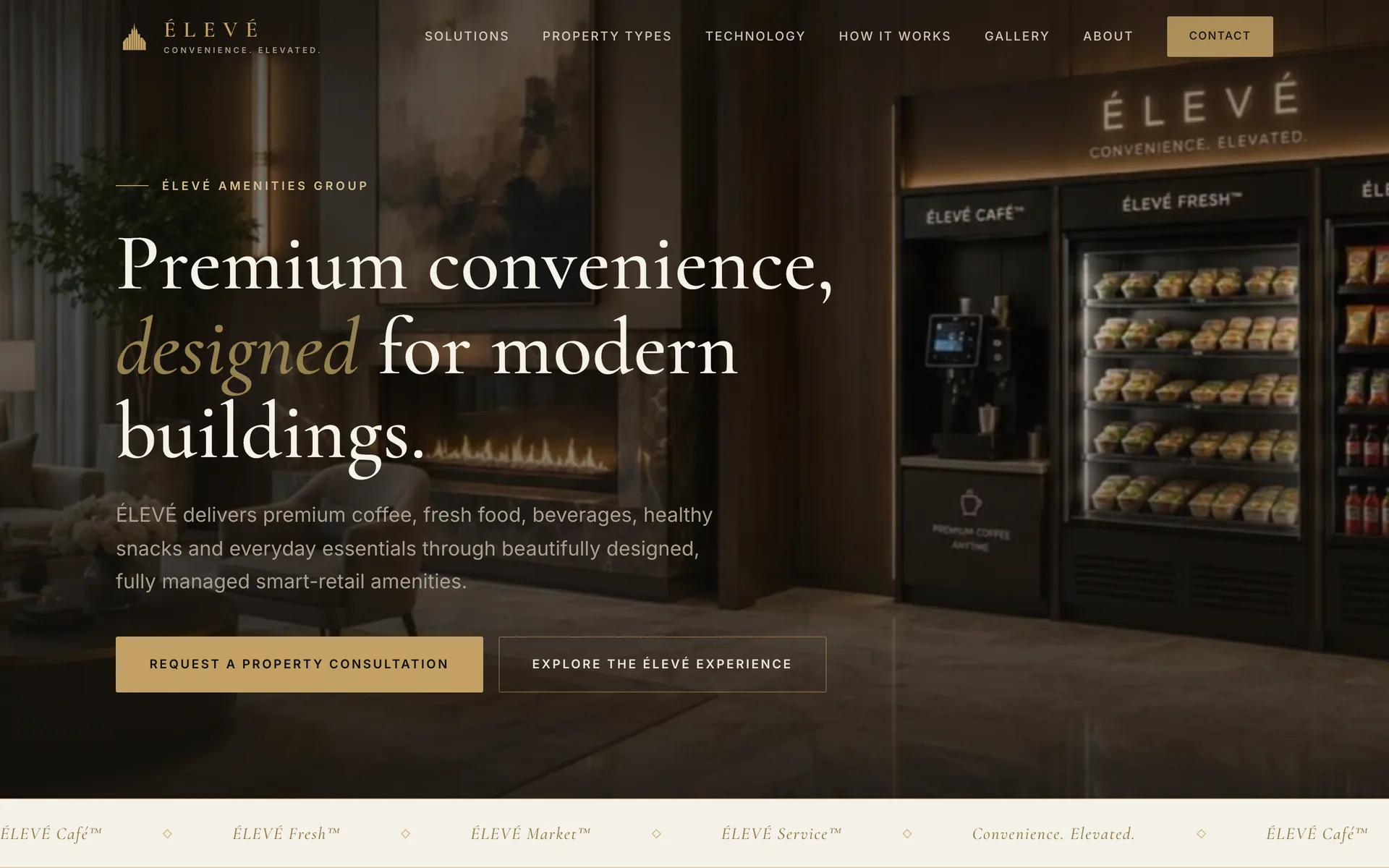
ÉLEVÉ puts automated, cashless retail inside residential buildings: a small unattended shop in the lobby, stocked and serviced by ÉLEVÉ rather than by the building.
The company sells into two rooms that care about opposite things. Owners want to know what an amenity does to lease-up speed and to the rent roll. Property managers want to know who restocks it, who fixes it at 11pm, and how many hours a week it will take out of their life.
ÉLEVÉ had the product, the vendor relationships and the client list. It had no website at all.
The decision
One narrative, two readers. The obvious move is to split the site into "for owners" and "for managers." We did not. A visitor rarely knows which bucket they are in, and forcing the choice on the first screen loses the ones who are curious but not yet committed. Every page answers in the same order instead: what the resident gets, then what the building gets. Owners self-select into the second half, managers read both.
Quiet, not loud. The visual direction came out of the lobbies the product lives in: near-black, a single warm gold, Cormorant Garamond set large with a lot of space around it. Premium residential buildings are understated, and their vendors are judged on whether they look like they belong there. A high-contrast, high-energy site would have read as the wrong kind of supplier.
The hard constraint was photography. The client's own close-ups were unusable, so the design had to carry the premium read through type, spacing and restraint rather than through imagery.
The build
Fifteen pages. Home, solutions, property types, how it works, technology, gallery, about, FAQ, contact, a three-article journal, plus terms and privacy. Custom work rather than a template.
A share calculator. A building owner enters their own unit count and sees the revenue split, so the commercial conversation starts from their numbers instead of ours.
A real lead pipeline. The contact form posts to a Cloudflare Worker and lands in a D1 database: not a mail script that fails silently, an actual queryable record.
First-party analytics. Cookieless page-view tracking through the same Worker into the same database, so the client sees traffic without handing visitors to a third party and without a cookie banner.
Static HTML, CSS and JavaScript, with self-hosted variable fonts. Deployed on Cloudflare Pages, so hosting costs the client nothing per month and the site does not go down when a plugin updates.
Where it stands
Launched and live on the client's own domain. The form works end to end, verified against the database.
That gap is worth stating plainly, because it is the most common thing that happens after a launch: the site is not the bottleneck, the absence of anyone pointing at it is. Search presence, a Google Business Profile and ongoing content are the next conversation, and they are a different job from building the thing.
What another client can take from this
A site can be finished and correct and still produce nothing, because launching is the middle of the project rather than the end. Budget for what happens after the build, or the build sits there.
The technical half of that is already solved here: because every enquiry and every page view lands in a database the client owns, the day the traffic conversation starts, the baseline is already being recorded.